On this page
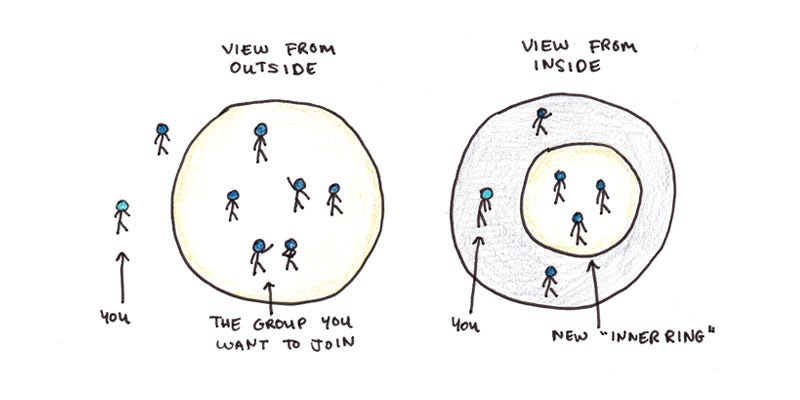
There’s a passage from C.S. Lewis that I think about often. In The Inner Ring, he describes an invisible force that shapes so many of our decisions—this quiet, persistent pull toward belonging, toward being part of whatever elite circle exists just beyond our reach. It doesn’t matter how much we accomplish or how far we go—there’s always another ring, another level, another option. And so, we chase.
Lately, I’ve been thinking about how this doesn’t just apply to status, but to the way we approach life itself. We live in an era of endless optionality—more career paths than we could ever pursue, more places to live than we could ever settle in, more relationships than we could ever commit to. On the surface, this seems like freedom. More choices should mean a better life, right? More paths to success, more chances to get it right.
But I’ve started to wonder if the opposite is true.
The more options we have, the harder it is to commit to any of them. We keep one foot out the door—always scanning for a better job, a better city, a better lifestyle—because choosing one thing feels like closing the door on everything else. And in trying to keep every possibility alive, we end up spread thin, never fully rooted in the life we’re actually living.
It’s not just that too many options make decisions harder. It’s that they create a perpetual state of hesitation. A lingering question of whether we could be doing better, whether we’re missing out, whether we’ve chosen wrong. And at some point, the weight of all those possibilities stops feeling like freedom—and starts feeling like a trap.
I’ve noticed this in myself. In the past year alone, I’ve found myself constantly revisiting my own decisions, not because I was unhappy, but because I couldn’t shake the feeling that maybe, just maybe, there was a better alternative. A different job that would challenge me more. A different project that would push me further. It wasn’t dissatisfaction that fueled these thoughts—it was the sheer abundance of choices, the knowledge that at any given moment, a hundred different lives were available to me if I just reached for them.
And yet, when I zoomed out, I saw that I wasn’t actually moving any faster because of this optionality—I was stuck. The paradox of choice wasn’t giving me more control over my life; it was keeping me in a loop of endless evaluation, always optimizing, never arriving.
I started to wonder: At what point does keeping our options open stop being a form of freedom and start becoming a form of avoidance?
We like to think that leaving doors open protects us from regret. But I’m beginning to think that regret doesn’t come from choosing wrong—it comes from never fully choosing at all.
the illusion of control.
We tell ourselves that keeping our options open is a form of power. That the ability to walk away at any moment, to pivot, to choose again and again, means we are in control. In theory, optionality gives us freedom—the freedom to select the best possible path, the freedom to avoid mistakes, the freedom to optimize our lives down to the smallest detail. But in practice, this kind of freedom often leads to the exact opposite: anxiety, hesitation, and a lingering sense of dissatisfaction.
Because when everything is possible, nothing ever feels certain.
Keeping our options open feels like control because it delays commitment. As long as we haven’t chosen, we can’t have chosen wrong. We get to live in the illusion that the perfect decision is still out there, waiting to be made. But the irony is that this refusal to choose is what keeps us stuck. Instead of gaining more clarity, we spiral deeper into indecision, mistaking endless evaluation for progress.
At some point, keeping our options open stops being a form of agency and starts becoming a form of avoidance. Real control isn’t about having infinite possibilities. It’s about having the confidence to make a choice and stand by it.
There’s a particular kind of peace that comes with full ownership of your decisions. When you stop scanning for alternatives, when you stop second-guessing whether you could be doing something better, you free up an immense amount of mental energy. Instead of worrying about what might have been, you get to focus on what is.
But ownership is terrifying because it also means taking full responsibility for your life. It means accepting that sometimes you will choose wrong, that you will make mistakes, that you will miss out on things—and that this is simply the cost of living a life of depth and meaning.
People often think regret comes from making the wrong choice, but more often, it comes from never fully choosing at all. It comes from living in a state of perpetual hesitation, always keeping one foot out the door, never committing fully to anything because we are afraid of what that commitment might mean.
confidence to close doors.
The strongest people I know aren’t the ones with the most options. They are the ones who have the confidence to close doors. To say: this is what I’m choosing, and I trust myself to make it work.
We think confidence is about knowing we made the right choice, but it’s not. It’s about being willing to choose despite not knowing. It’s about trusting that even if things don’t go exactly as planned, we will be able to adapt, to grow, to make the best of what we’ve committed to.
We chase optionality because we think it will give us control, but real control comes from letting go of the need to control every possible outcome. From understanding that life isn’t about always having the best option—it’s about being fully present in the option you do choose.
At some point, you have to decide: do you want the illusion of control, or do you want the clarity that comes from truly owning your life?
depth over breadth.
We glorify optionality because it makes us feel limitless. The idea that we can be anything, do anything, live any life we want—it’s intoxicating. But in reality, the people who accomplish the most, who build the deepest relationships, who experience true fulfillment, are rarely the ones who keep their options open forever. They are the ones who commit.
There’s a concept in physics called the observer effect: the act of measurement changes the outcome. And in life, something similar happens—when we refuse to commit, we never fully experience what could have been because we were never fully in it to begin with. The job we never gave 100% to, the relationship we always kept at arm’s length, the city we lived in while wondering if we should be somewhere else—each of these experiences remains incomplete, stunted by hesitation.
Depth requires sacrifice. To master something, you have to give up the fantasy of being great at everything. To have a meaningful relationship, you have to stop searching for a hypothetical "better" person. To build a life that feels rich and grounded, you have to be willing to plant roots instead of hovering above the ground, waiting for the perfect conditions to land.
And yet, we resist this. We tell ourselves that commitment is limiting, that choosing means losing. But what if it’s the opposite? What if the real limitation comes from skimming the surface of everything, never diving deep enough to find what’s truly meaningful?
True fulfillment isn’t found in endless exploration. It’s found in depth. In choosing something—fully—and letting the richness of that experience shape you. Because the reality is, no matter how many options you have, you can only live one life at a time.
The question is: will you spend it standing at the crossroads, or walking a path deeply enough to make it your own?
the weight of more.
We chase more because we think it will make us free. More options, more experiences, more paths to success—these are supposed to give us power. The ability to pivot, to optimize, to never be trapped. But at some point, more stops being liberating and starts being a burden.
Because the truth is, more is never enough.
There will always be another path we could have taken, another city we could have lived in, another version of ourselves we could have become. And the more we fixate on what we haven’t chosen, the less we experience the life we have. We spend our days running toward an ever-receding horizon, mistaking movement for meaning, optionality for progress. But what if the real challenge isn’t in doing more, but in stopping long enough to truly experience where we are?
The fallacy of wanting to do more is that it assumes breadth is the same as depth. That by adding, we are improving. But life doesn’t work that way. Mastery, meaning, connection—none of these come from scattering our attention across infinite possibilities. They come from choosing, from committing, from the courage to close doors.
At some point, we have to stop searching for the perfect path and start making something out of the one we’re on. Because a life spent hovering—never fully landing, never fully rooted—isn’t a life of freedom. It’s a life of hesitation. And in doing so, we become spectators in our own lives—always planning, rarely arriving.
More won’t save you. More won’t give you clarity. More won’t ever let you arrive. At some point, you have to decide: do you want to keep chasing, or do you want to finally live?
Because in the end, the life you want isn’t waiting on the other side of the perfect decision. It’s built through presence, through commitment, through the willingness to say: This is where I am. This is where I’ll grow.
If you enjoyed this, consider liking + subscribing :)